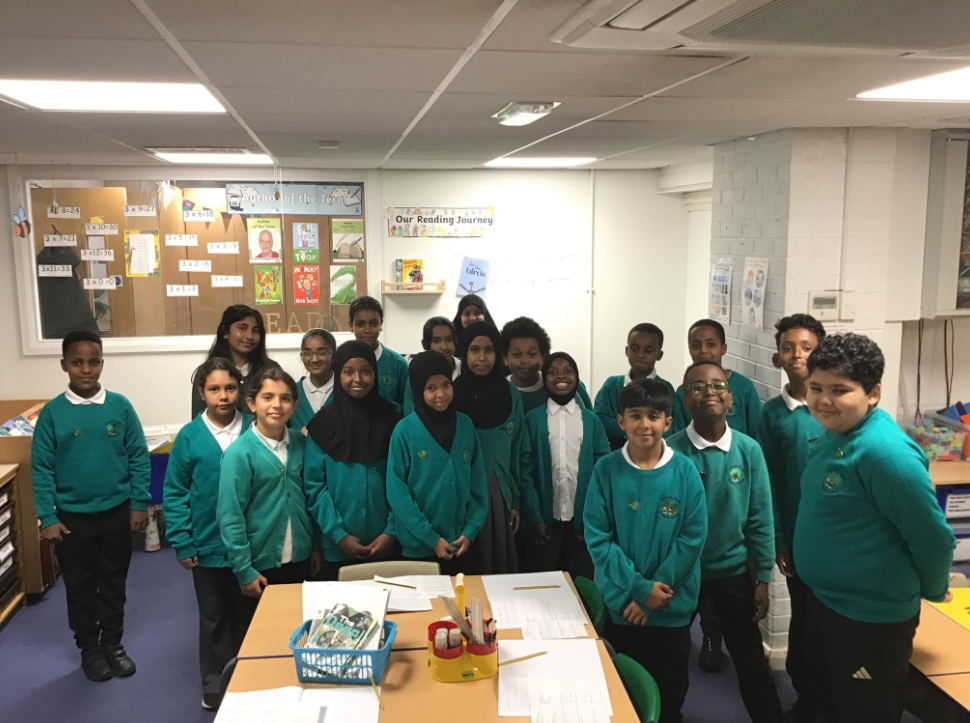
Pupil Leadership
Pupil Leadership Roles
School Council Representatives
- Represent the views and ideas of their class at fortnightly School Council meetings.
- Gather feedback and suggestions from their classmates.
- Help plan and lead school improvement projects.
- Share important updates and decisions with their class.
- Work with other pupils and staff to make positive changes across school.
Sports Leaders
- Help organise and support sporting activities and events.
- Encourage other pupils to get involved in physical activity and games.
- Support younger pupils during playtimes and sporting activities.
- Help promote teamwork, fairness and good sportsmanship.
- Represent the school at sporting events and activities where appropriate.
Eco Leaders
- Help our school become more environmentally friendly.
- Encourage pupils to reduce litter, recycle and look after our school grounds.
- Lead environmental campaigns and activities throughout the year.
- Share ideas for making our school more sustainable.
- Help pupils understand how small actions can make a big difference to our planet.
Value Ambassadors
- Promote and model our school values throughout the year.
- Encourage pupils to demonstrate positive attitudes and behaviours.
- Celebrate children who demonstrate our school values.
- Help organise activities and events linked to our values.
- Lead by example and be positive role models for others.
New Starter Leaders
- Welcome new pupils and help them settle into school life.
- Show new starters around the school and introduce them to important people and places.
- Help new pupils make friends and feel included.
- Be a friendly face that new pupils can talk to if they need help.
- Support new starters during their first few weeks at school.
Prefects
- Act as positive role models for younger pupils.
- Help maintain a friendly, respectful and safe school environment.
- Support staff and pupils with school events and activities.
- Take on responsibilities around school and help with important jobs.
- Demonstrate excellent behaviour, manners and leadership at all times.
House Captains
- Lead and support their house throughout the school year.
- Encourage pupils to take part in competitions, challenges and house activities.
- Promote teamwork, enthusiasm and positive competition.
- Help organise and support house events.
- Celebrate the achievements and successes of pupils within their house.
Future Leaders
- Take part in the cluster-wide Future Leaders programme with pupils from other schools.
- Develop leadership skills through workshops, activities and challenges.
- Explore key themes including communication, teamwork, resilience and making a difference.
- Work collaboratively with pupils from other schools and share ideas.
- Represent our school at Future Leaders events and the annual Future Leaders Summit.
- Use their developing leadership skills to make a positive difference in our school and wider community.
Learn about our Future Leaders Programme
Learn about our School Council
Learn about our Manchester United Leaders Programme
Pupil Leadership Strategy 2026/27
Together we explore, learn and grow.
Our Vision: Every Child a Leader, Every Voice Matters
At Haslam Park Primary School, we believe that leadership is not simply a position or a title. It is an opportunity for children to develop confidence, character, independence, responsibility and the belief that they can make a positive difference.
Our Pupil Leadership Strategy is rooted in our commitment to providing an ambitious, inclusive education that develops the whole child.
We want every pupil to understand that their voice matters, their contribution is valued and their actions can positively influence their school and wider community.
Leadership at Haslam Park is not reserved for a select few. It is an entitlement and an opportunity that we are determined to make meaningful for every child.
Our strategy ensures that leadership is embedded throughout school life, from everyday classroom responsibilities to formal leadership positions, pupil representation, sporting leadership and community initiatives.
We want pupils to experience leadership in practice: listening to others, making decisions, solving problems, taking responsibility and evaluating the difference their actions have made.
Above all, pupil leadership must be purposeful, inclusive and have a demonstrable impact on both the children involved and the wider school community.
1. Our Context and Rationale
Haslam Park serves a diverse community with significant levels of socio-economic disadvantage, a high proportion of pupils with special educational needs and disabilities (SEND), children who speak English as an additional language (EAL), and considerable pupil mobility.
We recognise that children arrive at school with different experiences, levels of confidence, communication skills and opportunities to take responsibility.
Some pupils may face additional barriers to accessing leadership opportunities or may not immediately recognise themselves as potential leaders.
Our context does not lower our expectations. It increases our responsibility to recognise potential, remove barriers and ensure that every child has opportunities to succeed.
We are particularly determined that disadvantaged pupils and pupils with SEND are not simply included in leadership opportunities, but are strongly represented, actively involved and supported to succeed.
We do not select pupils solely because they are disadvantaged or have additional needs. Equally, we do not leave equitable representation to chance.
Our approach is to recognise strengths and potential across the whole school population, actively encourage pupils who may otherwise be overlooked, and provide appropriate support to enable meaningful participation.
We want children to see leadership as something they can achieve, regardless of their background, attainment, disability, communication needs or starting points.
2. Our Strategic Aims
Through our Pupil Leadership Strategy, we aim to:
-
Provide leadership opportunities for every pupil, ensuring that responsibility and contribution are part of everyday school life.
-
Secure equitable representation, with particular attention to disadvantaged pupils and pupils with SEND.
-
Develop progressive leadership skills, including communication, collaboration, decision-making, organisation, resilience and independence.
-
Strengthen pupil voice and democratic participation, ensuring that children can influence decisions that affect them.
-
Develop character and personal responsibility, encouraging pupils to demonstrate empathy, integrity, respect and commitment.
-
Increase pupils' sense of belonging and self-worth, particularly for children who may experience barriers to participation.
-
Enable pupils to contribute positively to their school and wider community, through purposeful projects and leadership initiatives.
-
Evaluate the impact of leadership, ensuring that opportunities result in meaningful personal development rather than simply participation.
3. Our Leadership Model: Opportunities for Every Child
We recognise that leadership develops through experience, practice, encouragement and increasing responsibility.
Our model provides opportunities at different levels so that pupils can develop their leadership skills throughout their time at Haslam Park.
Universal Leadership – Every Child Has a Classroom Responsibility
Every child at Haslam Park has a personal classroom job or responsibility.
These roles ensure that leadership is not restricted to pupils who hold formal positions.
Classroom responsibilities provide regular opportunities for children to demonstrate reliability, organisation, teamwork, independence and care for their learning environment.
Responsibilities are displayed in classrooms and are reviewed and rotated every half term.
This approach enables pupils to experience different responsibilities, develop new skills and recognise the importance of contributing to their class community.
Where necessary, roles are adapted so that pupils with SEND can participate meaningfully and experience success.
Our expectation is that every child contributes, every child's contribution matters and every child develops a sense of responsibility.
School Council – Democratic Leadership and Pupil Voice
Our School Council provides pupils with opportunities to represent others, contribute to decisions and influence school improvement.
School Council representatives remain in their roles throughout the academic year, enabling them to develop relationships, sustain projects and take increasing ownership of their responsibilities.
Pupils are encouraged to identify issues, gather views, propose solutions, contribute to decisions and reflect on the impact of their actions.
Our School Council has already demonstrated meaningful influence through contributions to playground improvements, longer lunchtimes, breakfast club developments, charitable initiatives and environmental projects.
Pupil voice at Haslam Park must lead to genuine consideration, meaningful action and clear feedback to children about the decisions made.
Year 6 Leadership – Responsibility and Role Modelling
Our Year 6 Leaders take on more sustained responsibilities as the oldest pupils in school.
These positions provide opportunities to develop maturity, organisation, reliability, communication and positive role modelling.
Year 6 Leaders remain in their roles throughout the academic year, allowing them to consolidate their skills and demonstrate increasing independence.
They receive ongoing guidance and regular opportunities to reflect on their leadership responsibilities, successes and areas for development.
Our ambition is for these pupils to leave Haslam Park with greater confidence and the leadership skills needed for a successful transition to secondary education.
Wider Leadership – Sport, Community and Beyond
Leadership opportunities also extend beyond classroom and formal school positions.
These include sporting leadership, charitable initiatives, environmental projects, community partnerships and participation in wider programmes such as the Future Leaders Programme across Cluster 10.
These experiences enable children to apply leadership skills in different contexts, collaborate with others and understand the importance of making a positive contribution to society.
4. Inclusion and Representation – Leadership for All
A fundamental principle of this strategy is that leadership must reflect the diversity of our school community.
We recognise that providing the same opportunity to every child does not automatically guarantee equitable access.
Some pupils may require additional encouragement, adapted responsibilities, communication support, adult guidance or opportunities to practise skills before taking on more demanding roles.
We will therefore monitor leadership participation and representation across:
-
Pupils with SEND, including those with differing levels and types of need.
-
Disadvantaged pupils, including those eligible for pupil premium.
-
Different year groups and age groups.
-
Boys and girls.
-
Pupils from different backgrounds, including those learning English as an additional language.
-
Pupils who join the school at different points in the academic year.
-
Pupils with differing levels of confidence, attainment and prior leadership experience.
We will consider whether any groups are underrepresented and take purposeful action to address barriers.
This may include providing additional encouragement, adapting communication methods, offering supported leadership opportunities or creating different routes into leadership.
We will not assume that the most confident speakers or highest-attaining pupils are necessarily the most effective leaders.
We will identify leadership potential, not simply reward leadership skills that children already possess.
Inclusion in Action – Manchester United Sports Leaders
Our approach is demonstrated through our Manchester United Sports Leaders programme.
All pupils appointed as Manchester United Sports Leaders last academic year were children with additional needs.
We have retained these pupils in their roles for an additional year to allow them to consolidate their skills, strengthen their confidence and continue developing their leadership responsibilities.
This reflects our commitment to sustained personal development rather than short-term participation.
We want children to experience success, recognise their strengths and develop a positive identity as capable leaders.
At Haslam Park, children with SEND are not simply recipients of support. They are valued contributors, role models and leaders within our school community.
5. Developing Leadership Skills Progressively
We recognise that leadership is a set of skills and behaviours that can be explicitly taught, practised and strengthened over time.
Our strategy focuses on developing pupils' ability to:
-
Communicate: Express ideas, listen carefully and adapt communication to different situations.
-
Collaborate: Work with others, respect different perspectives and contribute to shared goals.
-
Take responsibility: Complete tasks reliably, demonstrate commitment and understand the consequences of decisions.
-
Make decisions: Consider options, solve problems and explain choices.
-
Show initiative: Recognise opportunities for improvement and suggest positive action.
-
Demonstrate resilience: Respond constructively to challenges, feedback and setbacks.
-
Develop empathy: Recognise the needs and experiences of others.
-
Act independently: Take increasing ownership of responsibilities with appropriate support.
-
Reflect and improve: Evaluate their contribution, recognise achievements and identify next steps.
We recognise that progress will look different for individual pupils.
For one child, success may involve speaking confidently to a group. For another, it may involve communicating a preference, completing a responsibility independently or working collaboratively with a peer.
Our focus is on meaningful development from each child's starting point, alongside ambitious expectations for what they can achieve.
6. Pupil Voice That Influences School Improvement
We are committed to ensuring that pupil leadership is not tokenistic.
Children must have opportunities to influence genuine decisions, rather than simply carry out tasks determined entirely by adults.
Pupil leaders will be encouraged to:
-
Identify an issue or opportunity for improvement.
-
Gather the views and experiences of other pupils.
-
Discuss possible solutions and consider different perspectives.
-
Present ideas and contribute to decisions with school leaders.
-
Help plan or implement agreed actions.
-
Review the outcomes and communicate what has changed.
Where an idea cannot be implemented, pupils should receive an age-appropriate explanation so that they understand how decisions are made and why competing priorities sometimes need to be considered.
Our You Said, We Did approach will help demonstrate that pupils are listened to and that their contributions are taken seriously.
We want children to understand that leadership involves both having a voice and accepting responsibility for how that voice is used.
7. How We Will Measure Success
We will evaluate the effectiveness of our strategy through two equally important measures:
Participation and representation: Who has access to leadership opportunities, and are these opportunities equitable?
Development and impact: What skills are pupils developing, what decisions are they influencing and what difference is their leadership making?
We will monitor:
-
The proportion and range of pupils participating in leadership opportunities.
-
Representation of pupils with SEND and disadvantaged pupils within formal leadership positions.
-
Participation across year groups and other pupil groups.
-
Whether every child has an appropriate classroom responsibility.
-
Pupil feedback about access, belonging, confidence and leadership experiences.
-
Development of communication, collaboration, independence and responsibility.
-
Evidence of pupils making decisions, solving problems and taking initiative.
-
Pupil-led proposals and initiatives that result in meaningful action.
-
The impact of projects on school life and the wider community.
-
Staff observations of pupils' developing leadership behaviours.
-
The extent to which pupils can explain their responsibilities and the difference they have made.
-
Progression in leadership skills as pupils move through school.
We will not judge success simply by the number of leadership badges awarded, roles allocated or activities completed.
Our evaluation will consider whether pupils have gained genuine responsibility, developed new skills and contributed to positive change.
8. Monitoring, Evaluation and Continuous Improvement
Pupil leadership will be monitored through a planned cycle of review, reflection and improvement.
Half-Termly Review
-
Review and rotate classroom responsibilities so that every child continues to experience meaningful opportunities to contribute.
-
Hold regular check-ins with Year 6 Leaders and School Council representatives.
-
Gather pupil feedback about responsibilities, achievements and challenges.
-
Review progress on pupil-led projects and identify next steps.
-
Provide additional support or adjustments where pupils experience barriers to participation.
Termly Review
-
Review participation and representation across pupil groups, particularly SEND and pupil premium.
-
Consider whether formal leadership positions reflect the diversity of the school community.
-
Gather staff observations and pupil voice evidence.
-
Review the impact of leadership projects on school life.
-
Identify pupils who may benefit from further encouragement or leadership development.
-
Share key findings and priorities with the wider leadership team.
Annual Evaluation
An annual evaluation will consider:
-
Whether the strategy has achieved its intended aims.
-
Whether all pupils have experienced meaningful opportunities for responsibility.
-
Whether disadvantaged pupils and pupils with SEND have been strongly represented and appropriately supported.
-
Whether leadership skills have developed over time.
-
Whether pupil voice has influenced genuine decisions.
-
Whether leadership initiatives have contributed positively to the school and community.
-
What needs to be strengthened in the following academic year.
Where evidence identifies gaps in participation, representation or impact, leaders will agree appropriate actions and review their effectiveness.
Monitoring will be used to improve provision and outcomes, not simply to record that activities have taken place.
9. Intended Impact on Pupils
Through this strategy, we intend that pupils will:
-
Develop greater confidence, self-belief and a positive sense of identity.
-
Recognise that their opinions and contributions are valued.
-
Demonstrate increasing independence, responsibility and resilience.
-
Communicate more effectively and work collaboratively with others.
-
Understand the importance of listening, fairness, empathy and respect.
-
Make informed decisions and take appropriate initiative.
-
Develop organisational, problem-solving and leadership skills.
-
Understand democracy, representation and social responsibility through practical experience.
-
Experience success in roles that challenge and develop their abilities.
-
Feel a stronger sense of belonging and ownership within the school community.
-
Recognise their capacity to make a positive difference.
-
Develop transferable skills that support their transition to secondary education and life beyond primary school.
For disadvantaged pupils and pupils with SEND, we are particularly determined that leadership experiences strengthen confidence, independence, participation and aspirations.
Our ambition is that every pupil leaves Haslam Park seeing themselves as someone who can contribute, influence and lead.
10. Intended Impact on the School and Wider Community
Successful implementation of this strategy will contribute to a school culture in which:
-
Pupil voice is respected, valued and acted upon.
-
Children are active partners in school improvement.
-
Leadership and responsibility are embedded in everyday school life.
-
Pupils demonstrate pride in their school and wider community.
-
Relationships are strengthened through cooperation, respect and shared responsibility.
-
Disadvantaged pupils and pupils with SEND are visible and valued within leadership.
-
Adults recognise and develop leadership potential across the full range of pupils.
-
Barriers to participation are identified and addressed.
-
Pupils make meaningful contributions to environmental, charitable and community initiatives.
-
Leadership is recognised as an important part of personal development, inclusion and preparation for life in modern Britain.
We want Haslam Park to be a school where children do not simply experience decisions made on their behalf, but have appropriate opportunities to help shape those decisions.
11. Leadership, Accountability and Governance
Emma Collett is the designated lead for pupil leadership and is responsible for coordinating the implementation, monitoring and evaluation of this strategy.
Her responsibilities include:
-
Overseeing the allocation and organisation of pupil leadership opportunities.
-
Supporting staff to ensure classroom responsibilities are meaningful and accessible.
-
Monitoring participation and representation, particularly for disadvantaged pupils and pupils with SEND.
-
Holding regular half-termly check-ins with Year 6 Leaders and School Council representatives.
-
Supporting pupil leaders to plan, implement and evaluate initiatives.
-
Gathering pupil voice and staff feedback.
-
Reviewing the impact of leadership opportunities.
-
Identifying barriers to participation and coordinating appropriate responses.
-
Reporting key findings, progress and priorities to the wider school leadership team.
-
Leading the annual review of the strategy.
Staff supporting pupil leaders will provide appropriate guidance, modelling and encouragement while ensuring that children retain genuine ownership of their responsibilities and projects.
School leaders will use monitoring findings to evaluate the effectiveness of the strategy and inform future development.
12. Leadership Roles for 2026/27
The school's Year 6 Leadership Team and School Council representatives for 2026/27 are identified below.
These pupils will remain in their roles throughout the academic year, providing continuity, accountability and opportunities for sustained leadership development.
In addition, every child across the school has an individual classroom responsibility. These roles are displayed within classrooms and reviewed and rotated every half term, ensuring that all pupils experience meaningful opportunities to contribute.
Our leadership structure is designed to balance sustained formal leadership with universal participation, so that every child has an opportunity to develop responsibility and experience success.
Our Commitment
At Haslam Park, we believe that leadership should be developed, not simply recognised; encouraged, not restricted; and made accessible, not left to chance.
Our context does not lower our expectations. It increases our responsibility to ensure that every child has the opportunity to flourish.
We are determined that disadvantaged pupils and children with SEND are not merely included in school life, but are strongly represented among those who shape it.
We want every child, whatever their background, needs or starting points, to experience the confidence that comes from being trusted, the pride that comes from making a contribution and the responsibility that comes with having a voice.
We do not simply want children to learn about leadership. We want them to experience it, grow through it and recognise that they have the power to make a positive difference.
Together we explore, learn and grow.